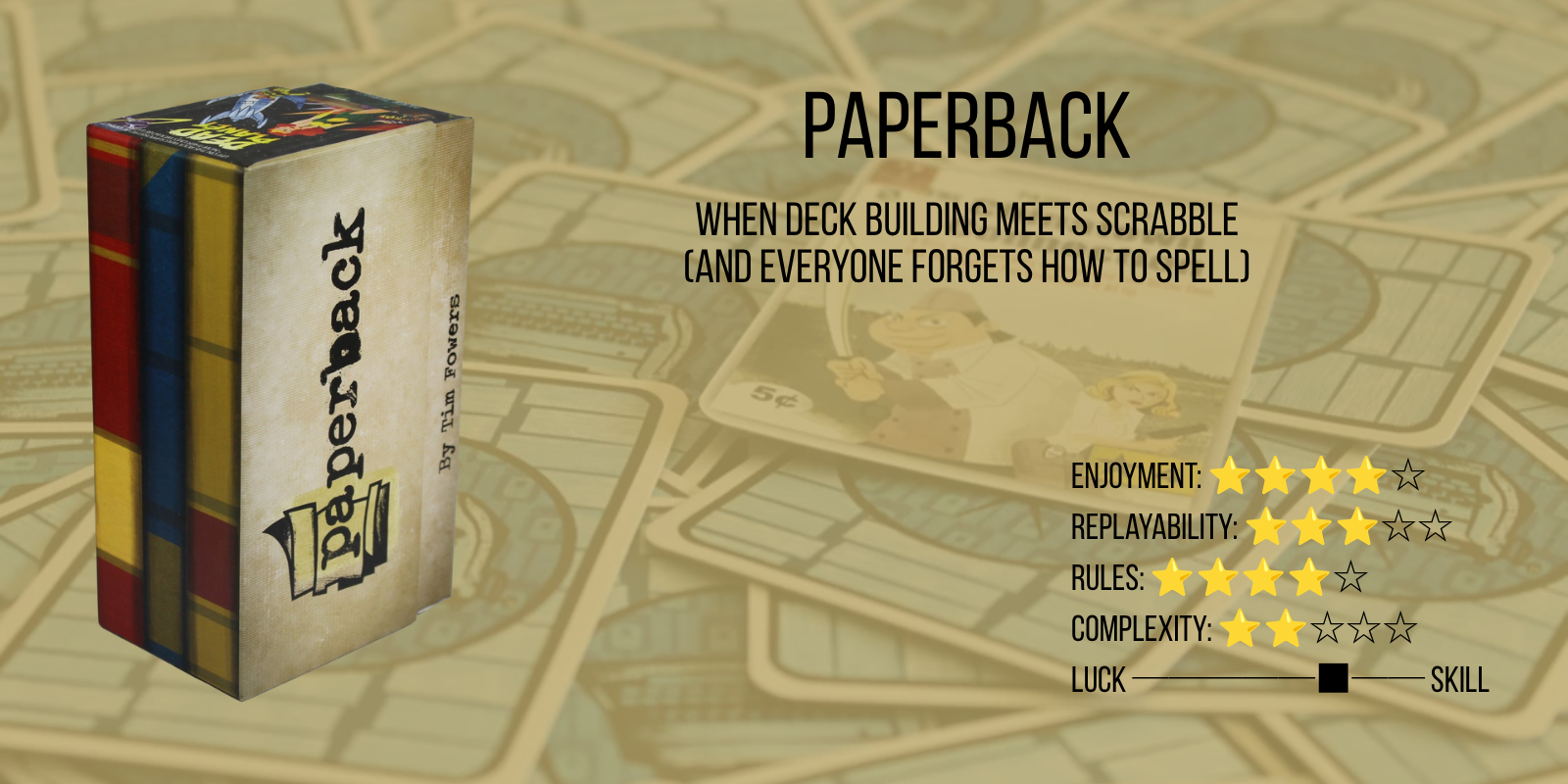
Enjoyment: ⭐⭐⭐☆☆
Replayability: ⭐⭐⭐⭐☆
Rules: ⭐⭐⭐⭐☆
Complexity: ⭐⭐☆☆☆
Luck ─────■── Skill
I absolutely love word games, am always thrilled to find high-quality German localizations, and have recently fallen hard for deck-building mechanics. When I first saw Paperback, the mid-century pulp-novel artwork and the hybrid concept immediately intrigued me.
We have played several rounds now across different player counts and groups, and our primary collective takeaway is simple: none of us can spell for shit. Even players with literal language degrees will stare blankly at a five-card hand and completely forget every word that has ever existed in the German language. It doesn’t make the game any less fun, though — in fact, that shared panic is where half the laughs come from.
How It Works: The Word-Powered Engine
At its heart, Paperback is a genuinely clever mashup of classic word games like Scrabble and modern market-driven deck building:
- You start with a basic personal deck containing simple letters and a few Fame/Wild cards which give you victory points but no points towards buying new words
- Each turn, you draw a hand of five cards and form the best word you can muster
- The letters used generate purchasing power (cents), allowing you to buy stronger individual letters (mostly consonants but also umlauts), powerful two-letter combo cards, or expensive Fame cards from the central market to add to your discard pile
What makes this far more interesting than standard word games is that the cards aren’t just raw point values — they come with built-in engine triggers. A card might let you draw extra cards on your next turn if your word has six or more letters, give monetary bonuses for specific letter placements, or let you trash junk cards out of your deck. You aren’t just trying to spell long words; you’re trying to build a synergistic letter engine.
Deck Bloat and German Compound Chaos
The core strategic dilemma revolves around Fame cards (the novels you are writing). Fame cards are essential because they represent the victory points needed to win the game. While they act as flexible Wild letters in your hand, they provide zero money or special abilities unless you happen to combine them with a letter that gives them a value. Buy too many Fame cards too early, and your deck becomes bloated with low-scoring dead weight, stalling your ability to afford the best premium letters.
The German edition localization feels thoughtfully adapted rather than lazily translated. The letter distributions, scoring values, and two-letter combinations are tuned to German frequency (letters rarely used in German have appropriately high payoffs).
Two specific notes on table rules:
- The Umlaut Decree: The game includes actual Umlaut cards (Ä, Ö, Ü). We quickly instituted a strict table rule: if you want an Umlaut, you must buy and use the actual Umlaut card — no substituting with “AE”, “OE”, or “UE”.
- Compound Word Shenanigans: German compound words lead to some absolutely absurd linguistic creations at the table. As long as you can justify the logic of the word, it flies.
Player Count, Pacing & House Rules
Paperback works best at 2 players, with 3 players as the functional maximum. Beyond that, downtime between turns can drag significantly while players agonizingly rearrange cards in their heads.
To keep the game moving, the included modular rules are fantastic:
- Timers are Mandatory for Some Players: Analysis paralysis can strike hard here. If you have players who want to calculate every permutation (we cannot give my dad unlimited turn time, or nobody else would ever get to play again), implementing a turn timer keeps the overall playtime to a crisp 30 to 45 minutes.
- The Bounty / Assistance System: If a player is completely stuck, offering a bounty cube to the table allows other players to suggest a word and earn a bounty they can put towards purchasing new letters or fame cards during their turn. It’s a wonderful mechanic that keeps everyone engaged on off-turns and prevents frustration when someone’s brain short-circuits.
- Mini-Modules: Later sessions with the included optional modules (like Theme cards and Award cards) added nice extra flavor, though the core game has plenty of pull on its own.
The Verdict
If you want the linguistic satisfaction of Scrabble without the restrictive board grid or the annoyance of two-letter tile memorization, Paperback is a massive upgrade. It’s accessible, stylish, and easily one of the best thematic word games I’ve played.
- Buy it if: You love word games, want a smooth introduction to deck-building mechanisms, enjoy 2-player linguistic duels, and appreciate great pulp-cover art and clean localization.
- Skip it if: You are prone to severe analysis paralysis with letter anagrams, prefer high-conflict interactive games, or are looking for a game to play regularly at 4 or 5 players.