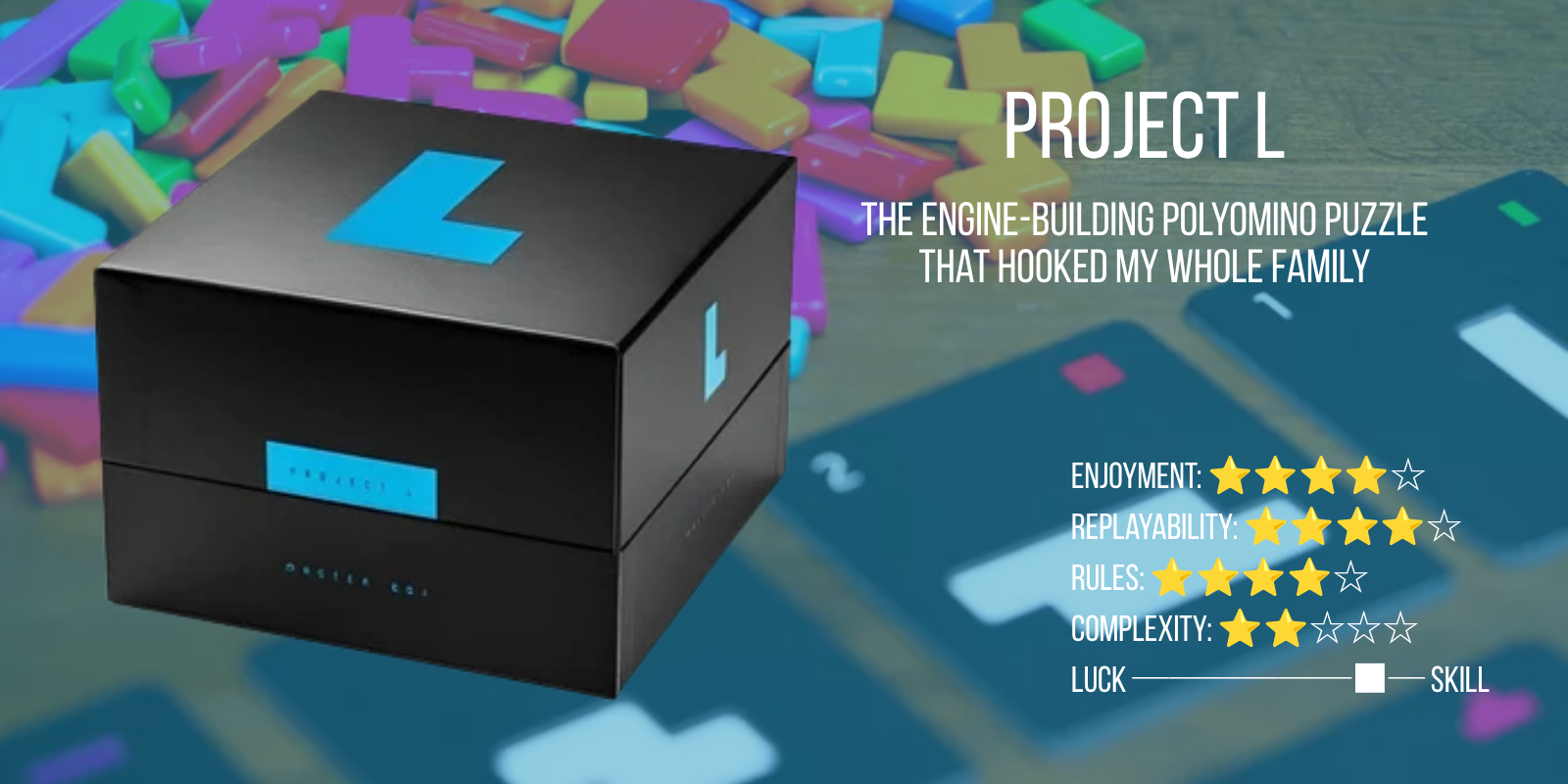
Enjoyment: ⭐⭐⭐⭐☆
Replayability: ⭐⭐⭐⭐☆
Rules: ⭐⭐⭐⭐☆
Complexity: ⭐⭐☆☆☆
Luck ──────■─ Skill
I backed Project L during its original Kickstarter campaign, immediately charmed by its crisp, minimalist aesthetic and vibrant Tetris-style polyomino shapes. After running through a few two-player sessions with my brother, it was obvious that the core rules were sleek and intuitive enough to introduce at family game night.
That turned out to be an understatement. My dad was so completely enamored with the game that we had to explain the entire concept of Kickstarter crowdfunding to him just so he could track down the Collector’s Edition Master Box and all of its expansions. Ever since, it has earned a permanent spot in our family game night rotation.
The Core Engine: Simple Actions, Pure Dopamine
At its foundation, Project L is an engine-building race wrapped in a spatial puzzle. On your turn, you have three actions to spend across five straightforward options:
- Draft a puzzle tile from the central market (up to a hand limit of four active puzzles).
- Take a Tier-1 piece (a basic single yellow square) from the supply.
- Upgrade a piece to the next tier (larger, more complex shapes) or trade it sideways for a different shape in the same tier.
- Place a piece from your pool into one of your active puzzle cutouts.
- Use the Master Action (limited to once per turn): Place exactly one piece into every single one of your active puzzles.
- Reset the market and deal a fresh row of puzzle tiles.
The strategic loop follows a satisfying progression: early on, you focus on simpler White puzzles to rapidly expand and upgrade your acrylic piece supply. As your piece pool grows in size and variety, you shift into high-gear, tackling point-dense Black puzzles.
When you finish a puzzle, you clear the pieces back into your supply, bank the tile for victory points, and gain the tile’s piece/upgrade reward. The absolute pinnacle of satisfaction in this game is lining up three or four complex puzzles and firing off a single Master Action to complete them simultaneously. It delivers an instant rush of mechanical dopamine that few engine builders can match.
Production & Tactile Joy
A massive part of what makes Project L so universally beloved at the table is its exceptional production quality:
- Recessed Dual-Layer Tiles: You aren’t just laying cardboard chits on top of flimsy cards. The puzzle boards are thick, double-layered tiles with recessed cutouts. The acrylic pieces snap snugly into place and won’t slide around if someone bumps the table.
- Vibrant Acrylic Shapes: The pieces are silky smooth, brightly colored, and wonderfully tactile.
- Streamlined Table Handling: The Master Box insert organizes every piece tier, tile type, and expansion neatly into fitted plastic trays, turning what could have been a messy baggie-sorting nightmare into an effortless two-minute setup and teardown.
Player Scaling, Pacing & The Expansion Breakdown
A standard game wraps up in a breezy 30 to 40 minutes (often even faster). Playtime varies slightly depending on whether someone at the table struggles with spatial visualization and needs an extra minute to rotate pieces in their head, but downtime between turns remains minimal.
While our primary sweet spot is 4 players, it scales remarkably well across the board: it’s sharp and competitive at 2 players, and the 5-to-6 player rules included with the expansions handle larger family gatherings without grinding to a halt.
As for the expansions, we permanently shuffle all puzzle tiles directly into the main market deck:
- Ghost Piece & Phoenix Expansions: Absolute essentials. The Phoenix tiles add tricky, high-scoring spatial challenges, while the Ghost Piece expansion introduces massive, chunky Tier-5 pieces. Playing without Ghost Pieces at our table would honestly cause a full-blown revolt — everyone loves drafting the big shapes.
- The Finesse Expansion: The most transformative module in the box. It introduces round-by-round objectives (e.g., completing specific puzzle types, placing certain shapes, holding specific piece tiers). Fulfilling them awards Finesse coins that let you purchase bonus actions or upgrade your final endgame scoring phase. It adds a crunchy layer of strategic planning that elevates the game considerably, though we leave it out when playing with casual or purely relaxed groups.
The Verdict
Project L takes the universal appeal of polyomino tiling and elevates it with tight action economy, smooth engine building, and brilliant components. It bridges the gap between casual gateway players and serious gamers effortlessly, offering near-infinite replayability.
- Buy it if: You love tactile polyomino puzzles (Patchwork, Isle of Cats), satisfying engine-building progressions, gorgeous minimalist production, and snappy 30-minute playtimes that appeal to every generation of your family.
- Skip it if: You heavily dislike spatial/visual puzzles, experience severe analysis paralysis when rotating shapes mentally, or require aggressive direct-player conflict and “take that” interaction.